
A cooling plate can help families keep the body of a person who has died safely cooled at home while they spend time together and prepare for the funeral, burial or cremation.
Amitayus and the Natural Death Care Centre purchased a cooling plate for community use in the Northern Rivers.
Please find below the user manual and if you would like to know more or organise hire please reach out to us.
Supporting families who choose to spend more time at home after death

What is a cooling plate?
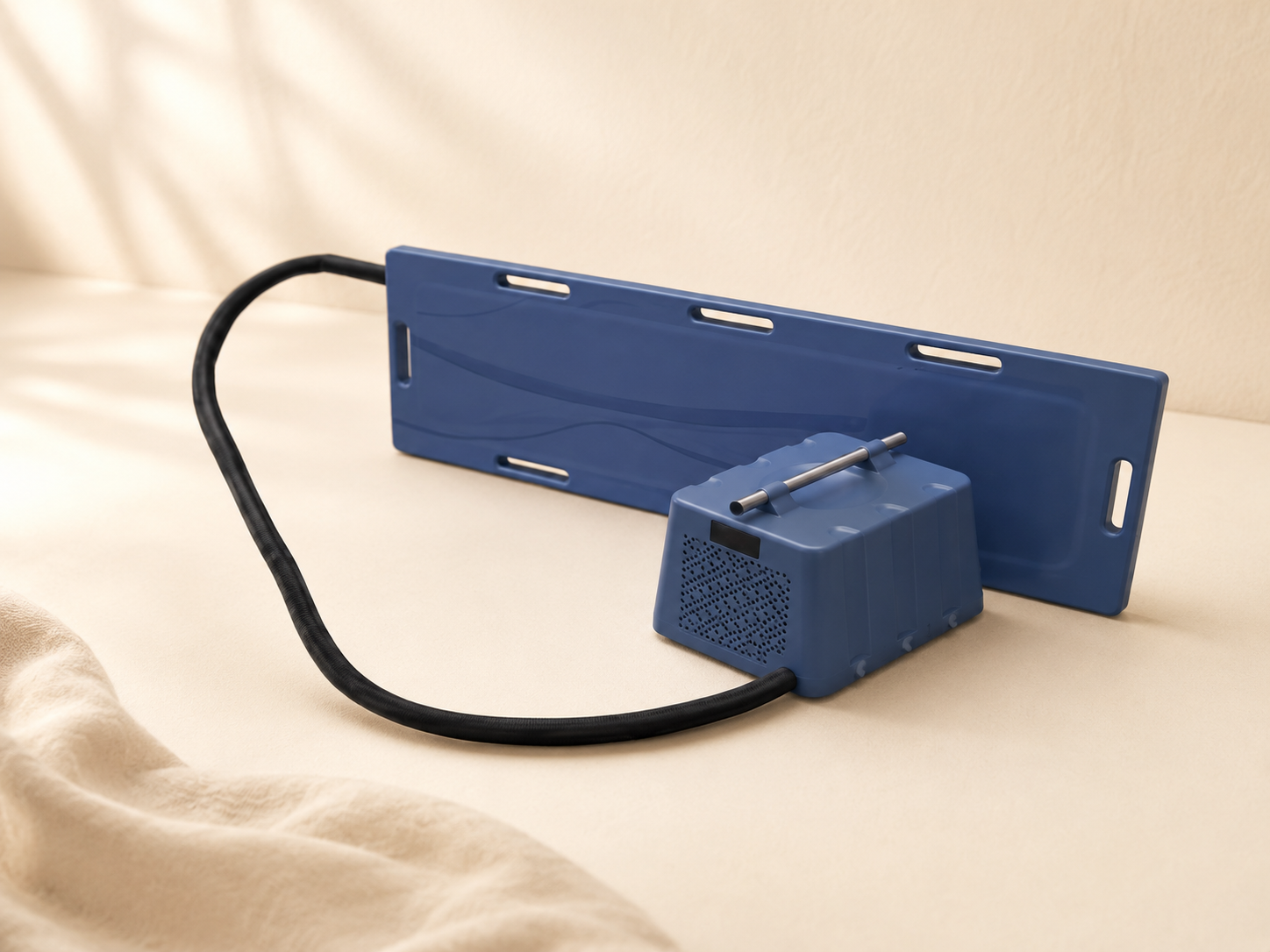
A cooling plate is an electrically powered refrigerated plate used to keep the body of a person who has died cool.
It allows families and friends to keep the person at home, or another suitable location, for a period of time before the funeral ceremony, burial or cremation. Cooling the body helps slow natural deterioration during this time.
The plate is positioned beneath the person and connected to a separate refrigeration unit. Detailed setup, care and operating instructions are provided in the user guide below.
Amitayus Home Hospice/Natural Death Care Centre
Cooling Plate User’s Manual & Guide
A Cooling Plate is an electrically powered refrigerated way of keeping a dead body cool to allow for home death care. AHHS & NDCC have purchased a Cooling Plate for community use.
It allows families or friends to keep a body refrigerated at home or elsewhere between death and the funeral ceremony or cremation/burial. In NSW you can legally do this for up to 5 days. During this time the body, especially the torso MUST be kept cold to stop it deteriorating.
Please read these instructions carefully.
We trust you will follow them responsibly, for your own benefit and the benefit of all future users.
The Cooling Plate is an expensive and delicate piece of equipment.
The responsibility for correct and continuing use is in your hands, just like the body of your person.If you don’t follow them correctly it may cause you or the body distress.We cannot emphasize this strongly enough.
Size plate: 440 x 940 x 35 mm and size box: 340 x 285 x 310mm
680 Watt
1.6 Amperage
temperature: 0C/-25C
220V-240V 50Hz
20.1 Kg
If you would like to know more or use this community asset please
contact JOHN: 0419485719. (AHHS)
Index
1. Good Cooling Plate Care and Preventing Damage
2. Carrying and Transport
3. Instructions for set up for use on a bed, floor or table
4. Body Care
5. Testing
6. Use with a Coffin
7. Operating Instructions Thermostat
8. Messages that may Display
9. Cleaning and Transport after Use
10. Record Hours of Use
AHHS & NDCC Cooling Plate InstructionsVersion: Version #3. February 2023. 1
1. Good Cooling Plate Care and Preventing Damage
The Cooling Plate is a compact sealed refrigeration unit which pumps a liquid coolant through the Plate. Through refridgeration decomposition of the body is delayed. Although the stainless steel or plastic Plate itself is sturdy, the Motor and the Hose are extremely delicate pieces of electrical and gas equipment.
It comprises three parts: the Plate, the Hose, and the Motor.
The Hose and the Motor are the most vulnerable parts. Any Hose damage will cause leakage and will prevent it from cooling the body.
So please:
• Never pick up the Plate or Motor by the Hose.
• Never kink or hard squeeze the Hose,
• At all times it must be able to move freely, including during transport.
• Never move or transport the Cooling Plate unit when the Plate is still frozen.
• NEVER turn it upside down, this will damage it completely.
• Never block the airflow to or from the Motor.
• Never cover the Motor when “ON”, or place it close to a wall.
It needs to dissipate heat and needs fresh air/ventilation.
• While in use: Place the feet on a towel to absorb any condensation fluid it may produce. Check regularly and replace towel if needed.
2. Carrying and Transport
One person can carry the Motor and Cooling Plate (21 kilos) by lifting the Plate in one hand, like a surfboard, and the Motor in the other.
With two people: place the Motor on top of the horizontal Cooling Plate or one person carries the Plate and the other the Motor while keeping the Hose from kinking or squeezing. It can fit in a standard car.
3. Instructions for set up for use on a bed, floor or table
• Place half a plastic sheet, table cloth or shower curtain over the surface on which the Plate will rest.
• Cover the plastic with towels or cloth to absorb any condensation.
• Place the Plate on top of the towels or cloth with the Hose towards either the foot (preferable) or head end.
• Fold the other half of the plastic over the top of the plate, then a thick towel or blanket on the plastic to stop the body from sticking or freezing to it.
• Keep the room temperature preferably below 25 degrees Celsius.
• Connect to power point and wait 10 seconds for cooling to start.
• The recommended temperature is between -17 °C and -20 °C.
• Reset if needed (see instructions below).
• When functioning: the Motor will shut down after reaching the set temperature and restart when needed to keep a steady temperature.
• The body can now be placed on the Plate. Ensure the base of the skull
all the way through to the tail bone of the spine are on the plate.
• The temperature of the cooling plate must be checked regularly.
• The body will get very cold, but not frozen solid.
AHHS & NDCC Cooling Plate InstructionsVersion: Version #3. February 2023. 2
4. Body Care
It's important to take into serious consideration the temperature of the room, ideally the room needs to be below 25 degrees celsius, if you have air conditioning in the room, set it to the lowest which is usually 16 degrees celsius. You may need to:
● Source a portable air conditioning unit.
● Use Techni Ice or frozen water bottles in addition to the Cooling Plate. Depending on the cause of death some bodies require different levels of care especially with the intense heat we experience on the Northern Rivers.
● If the body has trauma such as open wounds which will need to be gently washed & wrapped with a bandage, if they are on the front side of the body or on the limb you will need to place Techni Ice or an ice pack on them.
● Some cancers such as liver, pancreatic or stomach cause the body to decompose much faster & it is then necessary to place the Techni Ice or ice pack on the stomach. For brain cancer place them beside the head. Replacing them as needed, or 4-6hrs is usually sufficient. It can be helpful also to use a car windscreen insulator over the body as it keeps the cold in - this can be hidden with another piece of fabric to cover it. At night or when no viewing is taking place pull it up over the head area & always place extra Techni Ice or ice pack beside the head area through the night - especially if you are having the body at home for more than 3 days.
5. Testing
If you test the cooling plate without a body or coffin on it, then first cover the cooling plate with some sort of insulating material, such as cardboard or polystyrene, otherwise it will not get to the correct temperature.
6. Use with a Coffin
● The coffin and body can be placed directly on the Plate - only hardwood coffins. Cardboard or Wicker Caskets are not designed to withstand any form of condensation.The recommended temperature for this purpose is between - 22 °C and -25 °C
7. Operating Instructions Thermostat
The factory temperature settings for the Plate thermostat is -15°C.
To change the temperature setting:
Step 1: Press “Set”.
Step 2 : Change the temperature with the arrows up or down.
Step 3: Press “Set” to confirm.
8. Messages that may Display
PF = Broken hose or sensor defective (the Motor will run on emergency
program)
PR1 = Defective sensor
LOCK = Hold down the “Set” button for a few seconds, then the UNLOCK sign will appear and the Motor can be adjusted again.
AHHS & NDCC Cooling Plate InstructionsVersion: Version #3. February 2023. 3OUT1 = When the Motor and Plate reaches the set temperature, the message disappears.
9. Cleaning and Transport after Use
Turn off the Motor about 1 hour before you need to REMOVE the body to allow any ice formed on the towel or cloth, between the plate and the body, to thaw.
DO NOT force the separation. Remove the body for coffining and transportation as required.
Clean Plate, (Motor and Hose) thoroughly after use.
Please use Environmentally Friendly Products.
Return plate as soon as possible so others may be able to use it.
10. Record Hours of Use
Please record how many hours you had the Plate switched on and in use. This is crucial for maintenance purposes and the continual functioning as we need to know how the Plate is performing and when it may need re-gassing. These guidelines are clear and straight forward to help you in what may be an emotional time, just work through them carefully and refer back if you need to.
Compiled by Zenith Virago-Natural Death Care Centre, Halie Halloran-Paperbark
Deathcare Saskia Kouwenberg-Nimbin Death and Beyond. Sources: Hesselmans,
Mimi Zenzmaier-Sacred Earth Funerals, Amitayus Home Hospice Service & others.
AHHS & NDCC Cooling Plate InstructionsVersion: Version #3. February 2023. 4